
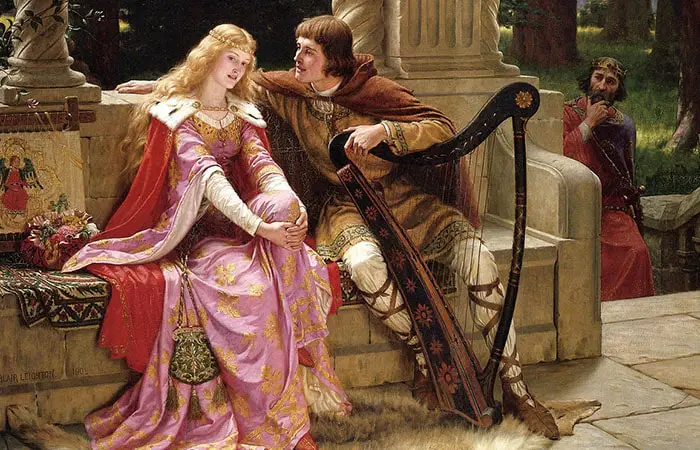
The legend of Tristan and Isolde is one of the most famous love stories in medieval European literature. Born between the 12th and 13th centuries in the Celtic Arthurian tradition, it recounts the tragic passion between Tristan, a knight at the court of King Mark of Cornwall, and Isolde the Fair, an Irish princess destined to become the king’s wife. The two fall in love after accidentally drinking a love potion during their journey to Cornwall. The story unfolds between Ireland and Cornwall, two territories that still retain physical and cultural traces of this legend. The tale has inspired operas, novels, and films, and has helped shape the literary identity of the British Celtic world. Travelling to England or Ireland means walking in the same lands where this story is set.
Tristan and Isolde: The legend of love that has spanned a thousand years of history
The legend of Tristan and Isolde is a tragic love story originating in Ireland and Cornwall. It is still told in plays, poems, and novels.
The story of Tristan and Isolde is a 12th-century Arthurian folktale, although it is believed to be much older, with some connections to Celtic legends.
It is the tragic adulterous love story between Tristan and Isolde, wife of Tristan’s uncle, King Mark of Cornwall, a classic love triangle that is ultimately shattered by death.
There are several versions of the legend of Tristan and Isolde, but they all maintain the same basic structure and plot. What you’ll find here is a summary based on the most widely accepted texts on English legends.
Tristan at the court of King Mark
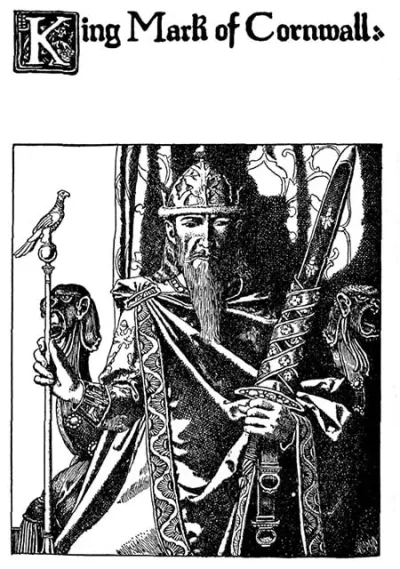 Young Tristan is taken to the court of King Mark of Cornwall, his uncle, where he receives an education in the art of chivalry, a skill in which the boy soon excels.
At that time, King Mark was obliged to pay homage to King Argius and Queen Isolde, the rulers of Ireland.
Once, to collect this payment, they sent their strongest and most feared knight, Moraunt, brother of Queen Isolt.
Tristan, to free his uncle from this form of subjection, decides to fight Moraunt in a duel to the death and seriously wounds him.
But Tristan also receives a wound in the leg, and Moraunt reveals to him that his sword is tainted with a deadly toxin, and the only one who can save him is his sister, Queen Isolde, who is a skilled healer.
Moraunt dies, and his body is brought home. There, his sister finds a shard of Tristan’s sword embedded in his skull and decides to carefully preserve it.
Healing in Ireland
Tristan, meanwhile, is only slightly wounded, but Moraunt’s poison slowly spreads through his body, preventing him from healing.
He then decides to seek out Queen Isolde, hoping she can do something for him. Arriving at the Irish court and aware of the queen’s affair with Moraunt, he presents himself under a false name.
Unaware of his true identity, Queen Isolt agrees to nurse him back to health and gradually begins to nurse him back to health.
The King and Queen of Ireland have a beautiful daughter, named after her mother, known as Princess Isolde the Fair. She nurses Tristan during his convalescence at the palace until she falls in love with him.
One day, while cleaning Tristan’s sword, a servant notices that it is chipped. He brings it to the queen, who, comparing it with the preserved shard, realises that it is the very weapon that killed her brother.
The woman demands the death penalty for Tristan, but the king decides to spare him, simply banishing him from his kingdom. Now cured, Tristan leaves Ireland and Isolde the Fair and returns to the court of King Mark.
Isabella, betrothed to King Mark
Back home, Tristan tells King Mark about Isolde the Fair in such glowing terms that his uncle becomes infatuated with her and asks Tristan to return to Ireland and bring him Isolde the Fair as his wife.
Tristan obeys. In Ireland, he begins to have conflicting feelings because he promised his uncle he would bring him the princess, but he himself is in love with her.
Although torn, he keeps his promise and asks King Argius to grant Isolt’s hand to King Mark, then they set off to return to Cornwall.
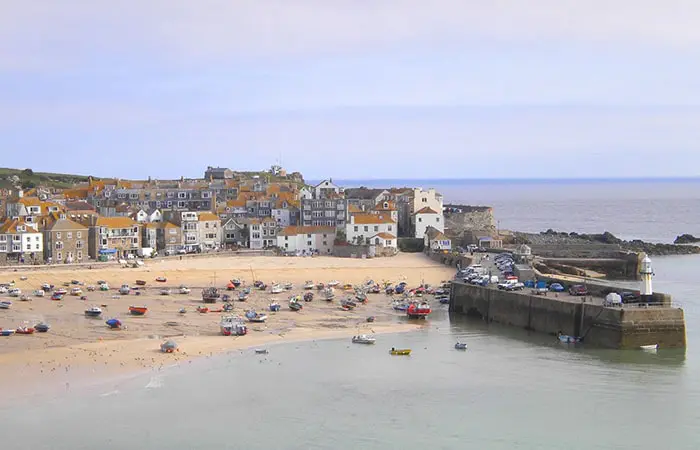
Meanwhile, the queen, to ensure her daughter a happy marriage, gives a love potion to the girl’s servant, asking her to administer it to her and King Mark as soon as they arrive at the palace.
During the journey, however, Tristan and Isolde, overcome by thirst, find the mysterious vial and drink it, believing it to be water. The two finally give in to their love, now destined to be impossible.
This does not stop the plans, and Isolde the Fair marries the king. But the potion has already taken effect and, despite the recent wedding, Tristan and Isolde love each other even more than before .
Tristan is banished
Shortly thereafter, King Mark discovers the love between the two boys. Furious, he banishes Tristan from the kingdom. He begins to wander aimlessly until he finds himself at King Arthur’s court in Camelot, where he is invited to join the Knights of the Round Table.
King Mark, driven by jealousy, decides to disguise himself and go to Camelot to kill his nephew, taking Isolt with him. While the king searches for Tristan, Isolt is kept safe in an abbey.
One day, walking in the woods, she encounters her beloved. The two spend three happy days together, but then Tristan decides to take her back to her husband. The king’s plan to kill Tristan fails, so he returns to Cornwall with his wife.
Tristan, now alone and hopeless again, believing he would never find happiness again, sets out for Brittany and finds himself at the court of King Hoel.
At that time, Brittany was under attack, and Tristan volunteered to lead the Breton army. With his skill at arms and courage, he easily freed the Bretons from the invaders.
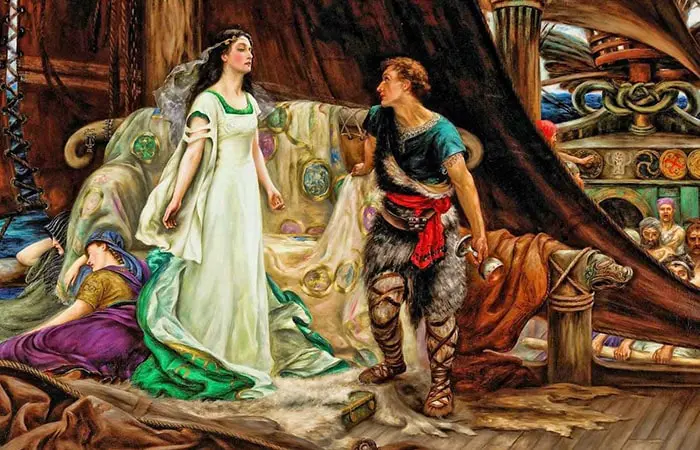
Isolt with the White Hands
In gratitude, King Hoel offers him his beautiful daughter in marriage. The girl shares the name of Tristan’s first love, Isolde the Fair, but was known as Isolde of the White Hands.
Tristan finds himself at odds with his heart. Although he loved Isolde the Fair with all his heart, he knew they could never live happily together. After much hesitation, he agrees to the marriage.
The two spend many months in peaceful happiness in each other’s company, but soon Tristan is called away to fight his enemies and is struck in the head. Taken home by his wife, the knight begins to recover, while his love for Isolde of the White Hands grows.
But a dark illness takes hold of him and prevents him from regaining his strength. Finally, in despair, he tells his wife how Isolt the Fair had once healed him and begs her to send for her.
Isolde of the White Hands sends Gesnes, the best sailor in the kingdom, to Cornwall to ask Queen Isolde the Fair to accompany him to Brittany to rescue Tristan. Before leaving, Tristan tells Gesnes:
“If she agrees to come, before you return, rig your ship with white sails, and we will be notified of her arrival. If she refuses, hoist the mast with black sails, for then my death will be near.”
Without hesitation, Isolde the Fair agrees to join Tristan. While awaiting their arrival, however, Tristan’s health continues to rapidly deteriorate.
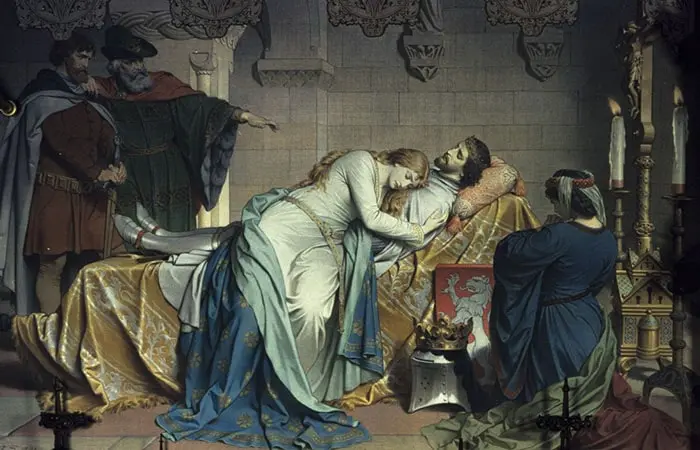
The Deception of Isolt the White Hands
Meanwhile, Tristan’s jealous wife fears that the arrival of Isolde the Fair could rekindle their love and destroy her own happiness. So, when she sees the ship with white sails approaching, she decides to lie and tell Tristan that the sails are black.
The man, disappointed and exhausted, breathes his last. When Isolt the Fair sets foot on land, she receives the terrible news and, with grief, as soon as she sees the lifeless body of her beloved, dies at his side.
The two bodies were taken back to Cornwall, where a repentant King Mark ordered them to be buried in his own chapel.
After a short time, a beautiful vine begins to grow from Tristan’s tomb, climbing up the wall and descending until it joins the tomb of Isolde the Fair.
The vine is cut down several times, but each time it begins to grow again, always pushing towards the tomb of the princess who died for love.
End of the unhappy love story
The story of Tristan and Isolde remains one of the greatest love stories of the Arthurian world, portrayed in many works of art, songs, poems, tales, operas and films, in many languages and in many countries around the world.
It is one of those evergreen stories that, like the vine that grew from Tristan’s grave, returns again and again and never dies.
FAQ
Is Tristan and Isolde a true story or a legend?
It’s a medieval literary legend, not a historically documented story. The tale’s origins lie in pre-Christian Celtic traditions, likely much older than the 12th century, when it was first written down. There are several versions of the legend, but they all share the same structure: the love triangle between Tristan, Isolde, and King Mark, the love potion, and the tragic ending.
Where does the legend of Tristan and Isolde come from?
The legend has Celtic origins and is set between Ireland and Cornwall, in southwest England. It became part of the Arthurian tradition of the 12th century, where Tristan is depicted as one of the Knights of the Round Table. The best-known versions are medieval French ones, but the core of the story is clearly of British and Irish origin.
Where is the story of Tristan and Isolde set?
The main locations of the legend are King Mark’s court in Cornwall, the kingdom of Ireland from which Isolde originated, and the sea that separates them, where the love potion is drunk. Travellers to Cornwall can still visit Castle Dore, identified by some scholars as King Mark’s historical seat. In Ireland, the Celtic legends that fuelled the tale of Tristan and Isolde live on in oral tradition and archaeological sites.
Who inspired the character of Isolt?
Isolt the Fair is an archetype of the Celtic woman: beautiful, powerful, and tragically trapped between duty and love. Her name and some of her characteristics hark back to the goddesses and warrior queens of Irish mythology. In legend, there are actually two Isolts: the Queen of Ireland, mother and healer, and her daughter Isolt the Fair, the protagonist of the love story.
Where can you experience the places of Tristan and Isolde?
Cornwall, in southwest England, is the land most closely linked to legend. Tintagel, once associated with the birthplace of King Arthur, is one of the most visited Arthurian and Celtic sites in the United Kingdom. Ireland, where Isolt originated, preserves a Celtic tradition that is still very present in the landscape and local culture. Those who choose a study holiday in Great Britain or Ireland have the opportunity to explore these places firsthand, within a culture that still inhabits them today.