A long, long time ago, in a castle far, far away, a boy was born to King Uther Pendragon. With Britain facing troubled times, the wise wizard Merlin arranged for the child to be raised in secret, hiding his true identity as the king’s heir.
Years later, King Uther Pendragon died. With no obvious successor to the throne, the question of who should rule Britain remained unresolved.
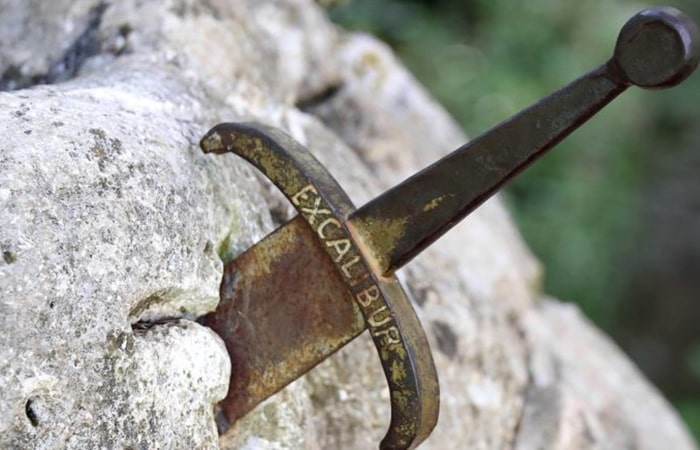
According to one of the best-known versions of the legend, a sword appeared in a stone, accompanied by the message that whoever could pull it free was the rightful king.
Many tried, hoping to claim the throne, but nobody could remove the sword. Then the young Arthur succeeded where everyone else had failed.
His achievement revealed his royal destiny and, eventually, Arthur became the legendary King of the Britons.
Who was this boy? King Arthur, of course!
The legend of King Arthur
This story might sound familiar if you grew up watching Disney’s famous animated film or have seen one of the many films or read one of the books inspired by the legends of King Arthur and the Knights of the Round Table.
Merlin and the sword in the stone, Excalibur, are only two parts of the much larger collection of stories surrounding Arthur. Though there is an excellent British show, Merlin, if you are interested in that aspect of the story!
There is Camelot, the legendary home of Arthur’s court, and Queen Guinevere, his wife. There is also Excalibur, Arthur’s famous sword, although different versions of the legend do not always treat Excalibur and the sword in the stone as the same weapon.
Then there is Sir Lancelot, one of the most famous of Arthur’s knights. The Knights of the Round Table and their quest for the Holy Grail have inspired stories for centuries.
Arthur is traditionally described as a great warrior who defended the Britons against the invading Anglo-Saxons. But is there any truth behind these stories, or are they simply myths and legends?
There is no simple answer. Historians have spent centuries examining the possible origins of the Arthurian stories, but there is still no firm historical evidence proving that King Arthur existed as the individual described in medieval legend.
Is there any evidence that King Arthur really existed?
One of the biggest problems facing historians is the lack of contemporary evidence.
Arthur does not appear in the surviving written accounts from the period in which he is traditionally supposed to have lived, around the fifth or sixth century.
One of the earliest surviving texts to name Arthur is the ninth-century Historia Brittonum, or History of the Britons. The work was traditionally attributed to a Welsh monk called Nennius, although modern scholars do not consider his authorship certain.
The Historia Brittonum associates Arthur with 12 battles against the Saxons, portraying him as a warrior rather than the medieval king we recognise today.
More stories followed over the centuries, gradually creating the Arthurian world we now know.
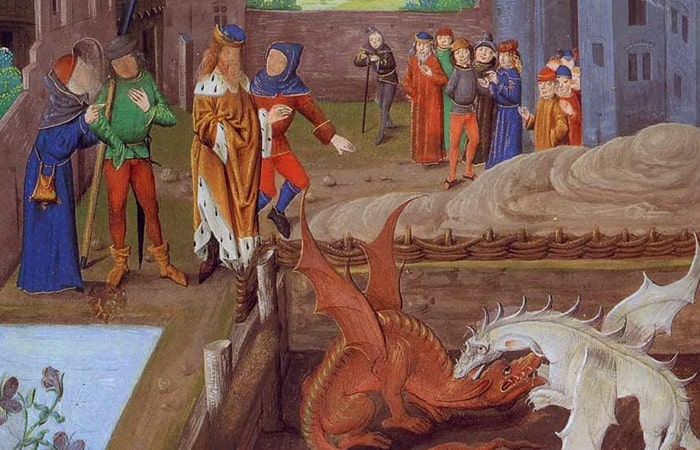
One of the most influential was Geoffrey of Monmouth’s 12th-century History of the Kings of Britain. Completed around 1138, Geoffrey’s work helped establish many of the familiar elements of Arthur’s story and transformed him into a major figure in medieval European literature.
Later writers continued adding characters, adventures and traditions. Camelot, the Round Table, Lancelot, the Holy Grail and other famous parts of Arthurian legend developed across different texts rather than appearing together in one original story.
So, was there ever a real King Arthur?
Nobody knows for certain. Some historians have suggested that the stories could have developed around the memory of a real British military leader who fought against Anglo-Saxon expansion after the end of Roman rule.
Another possibility is that Arthur is a legendary figure whose story combines elements of several different historical people, folk traditions and later medieval literature.
Whatever the answer, Arthur’s influence on British history and culture is very real.
Places where you can experience the legend of King Arthur
Stories about Arthur and his knights have been retold for centuries.
Writers, poets, musicians and filmmakers including Sir Thomas Malory, Alfred, Lord Tennyson, Rick Wakeman, Monty Python, Bernard Cornwell and Guy Ritchie have all created their own versions of the Arthurian world.
Whether you believe there was a historical Arthur or not, there are several places in England where you can see how strongly the legend has become connected with real British landmarks.
Here are some of the most interesting places to visit if you want to follow the story of King Arthur.
Contents
The Round Table
The Round Table is one of the most recognisable symbols of Arthurian legend.
Its circular shape meant that there was no obvious head of the table, reflecting the idea that Arthur’s knights met as equals.
Different medieval versions tell the story differently. In Sir Thomas Malory’s Le Morte Darthur, for example, the table eventually comes to Arthur through King Leodegrance, Guinevere’s father, as part of her marriage to Arthur.
You obviously cannot visit Arthur’s original Round Table because there is no historical evidence that it existed.
But you can see something rather impressive in the Great Hall in Winchester.
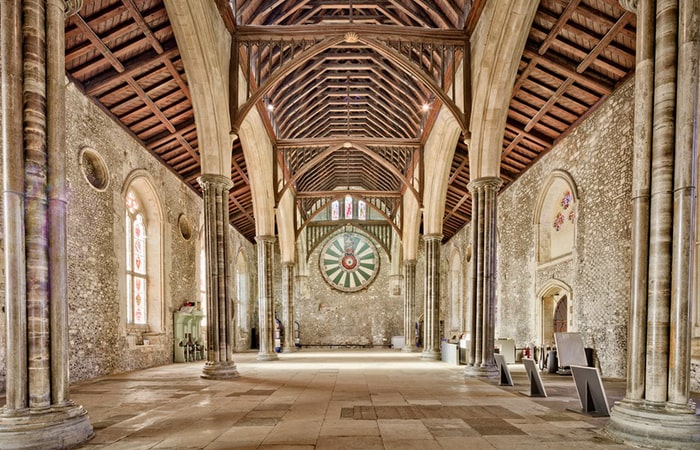
The enormous wooden Winchester Round Table has hung in the Great Hall for centuries. It dates from the Middle Ages rather than Arthur’s supposed lifetime and is thought to have been made during the reign of Edward I, a king with a strong interest in Arthurian tradition.
The table was later repainted during the reign of Henry VIII. Its Tudor design includes a Tudor rose at its centre and a depiction of King Arthur that bears a striking resemblance to Henry VIII himself.
Around its edge are the names of Arthur’s knights.
It might not be the real Round Table, but it shows just how powerful Arthur’s legend had become among England’s medieval and Tudor monarchs.
Stonehenge
Stonehenge is probably the most famous prehistoric stone circle in England.
Construction at the site began thousands of years before the period traditionally associated with Arthur, so we know that neither Arthur nor Merlin was responsible for building it.
Medieval storytellers had other ideas.
In the 12th century, Geoffrey of Monmouth included Stonehenge in his History of the Kings of Britain. According to his story, the stones had originally stood in Ireland and possessed remarkable properties.
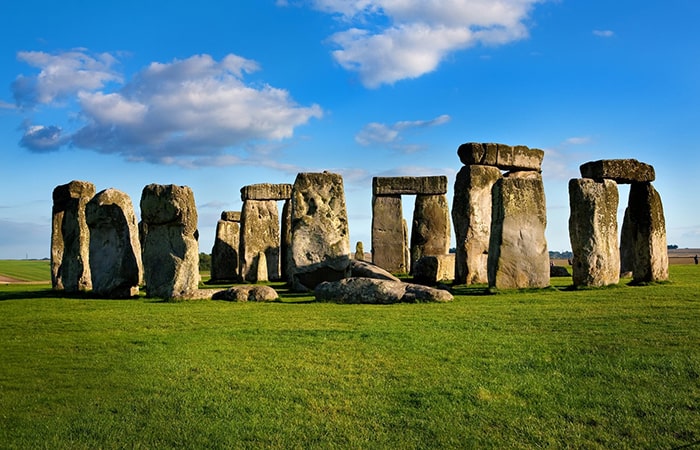
Aurelius Ambrosius wanted to create a memorial to Britons who had been killed by the Saxons, so Merlin advised him to bring the stones to Britain.
The men sent to retrieve them were unable to move them, but Merlin succeeded through his own extraordinary abilities. The stones were then transported to Salisbury Plain and reconstructed there.
Of course, archaeology tells us a very different story. Stonehenge was created over a long period beginning around 3000 BC, thousands of years before Geoffrey’s fictional account.
The legend does, however, show how medieval writers tried to explain an ancient monument whose real origins had long been forgotten.
Arthur’s birthplace
Cornwall has some of the strongest connections with Arthurian legend.
Most famous of all is Tintagel, on Cornwall’s dramatic north coast.

In Geoffrey of Monmouth’s version of the story, Arthur was conceived at Tintagel after Merlin used magic to disguise Uther Pendragon as Gorlois, Duke of Cornwall. Uther was then able to enter Tintagel and sleep with Gorlois’s wife, Igraine.
It is a much darker story than some modern retellings of Arthur’s origins suggest, involving deception and a woman who believed Uther was her husband.
The connection between Tintagel and Arthur became so famous that Richard, Earl of Cornwall, built a castle there in the 13th century, hundreds of years after Arthur was supposedly alive.
Archaeology has revealed something interesting too.
Long before Richard’s castle was built, Tintagel was an important settlement between approximately the fifth and seventh centuries, exactly the broad period traditionally associated with a possible historical Arthur. There is no evidence that Arthur himself lived there, but the site appears to have been a high-status stronghold with trading links stretching as far as the Mediterranean.
Today, the ruins of Tintagel Castle lie across the mainland and a rocky headland, now connected by a modern footbridge opened in 2019.
Below the cliffs you will also find Merlin’s Cave, which can be reached from the beach when tidal conditions allow.
Arthur’s final battle and Avalon
No tour of Arthurian Britain would be complete without Glastonbury.
This Somerset town has been associated with Arthur for centuries and is closely connected with one of the most mysterious places in Arthurian legend: Avalon.
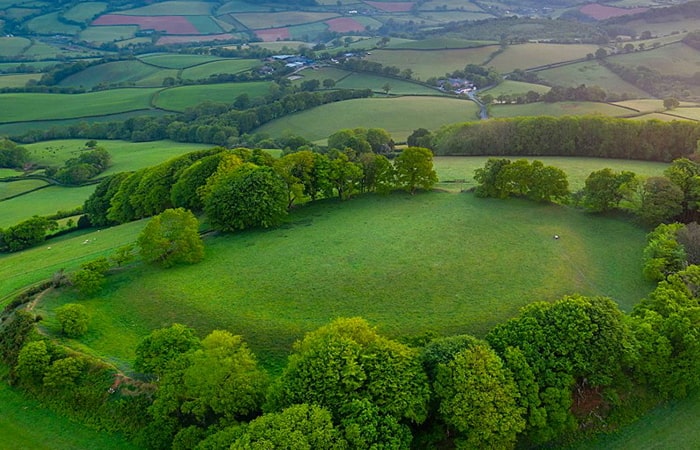
According to medieval stories, Arthur was mortally wounded during his final battle against Mordred at Camlann. He was then taken to the mysterious Isle of Avalon.
Over time, Glastonbury became strongly associated with Avalon, partly because the surrounding Somerset Levels were once much wetter than they are today. Glastonbury Tor, rising dramatically above the surrounding landscape, could easily appear island-like when the lower ground was flooded.
That does not prove that Glastonbury was Avalon, of course. Avalon belongs to Arthurian tradition and its real-world location, if it ever had one, remains unknown.
The surrounding landscape has nevertheless accumulated plenty of Arthurian connections.
Cadbury Castle, an Iron Age hillfort in Somerset, has sometimes been suggested as a possible inspiration or location for Camelot. Archaeological evidence shows that the site was occupied and fortified during the post-Roman period, although there is no evidence identifying it as Arthur’s court.
At the foot of Glastonbury Tor you can also visit Chalice Well, which has become associated in later tradition with the Holy Grail.
History, archaeology, folklore and later storytelling all overlap here, which is part of what makes Glastonbury such an interesting place for anyone fascinated by Arthur.
The supposed remains of King Arthur
Glastonbury’s connection with Arthur became particularly famous in 1191.
A few years earlier, in 1184, a devastating fire had destroyed much of Glastonbury Abbey. The monks began rebuilding, but the project required considerable money.
Then came an extraordinary discovery.
In 1191, the monks announced that they had found the grave of King Arthur and Queen Guinevere in the abbey grounds.
Contemporary accounts describe the discovery of human remains together with a lead cross carrying an inscription identifying the grave with Arthur and Avalon.
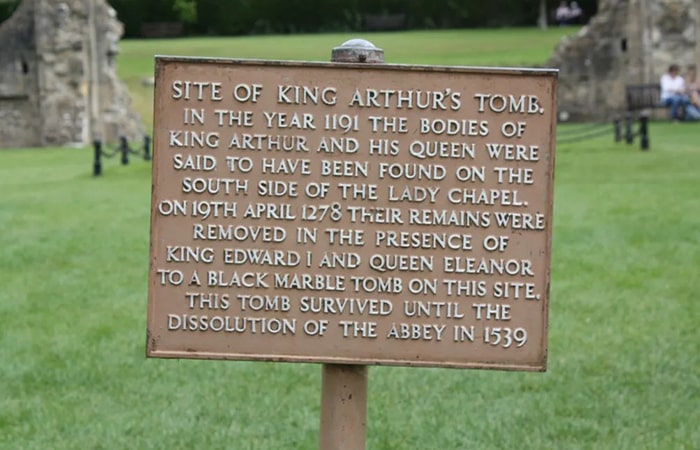
The discovery attracted enormous attention, but modern historians do not regard it as reliable proof that Arthur existed or was buried at Glastonbury. The abbey itself now acknowledges that the supposed discovery was almost certainly not genuine.
The story nevertheless became part of Glastonbury’s history.
In 1278, the supposed remains of Arthur and Guinevere were reburied in a grand ceremony attended by King Edward I and Queen Eleanor of Castile.
Their tomb remained an important feature of the abbey for centuries.
Glastonbury Abbey was eventually dissolved under Henry VIII in 1539 and much of the complex fell into ruin. Nothing physical remains of Arthur’s medieval tomb today, although visitors can still see the site traditionally associated with it within the abbey grounds.
So, what do you think?
Was there once a real warrior behind the stories of King Arthur? Could Camelot have been inspired by a genuine stronghold somewhere in Britain?
We may never know exactly where history ends and legend begins. But more than a thousand years after the earliest surviving stories about Arthur appeared, the king, his knights and their adventures remain some of Britain’s most famous legends.