
When you start looking into facts about the British Museum, you quickly realise that its importance cannot be reduced to a handful of statistics!
If you are planning to visit London, understanding these facts about the British Museum will change the way you walk through its galleries. Its history is tied to the development of public museums, to Britain’s imperial past, and to ongoing debates about cultural heritage.
Founded on the private collection of Sir Hans Sloane and steadily expanded over centuries, the museum now stands as one of the most influential cultural institutions in the world. Each gallery reflects layers of collecting, scholarship and architectural transformation.
Contents
1. It was founded on a private collection that changed public access to knowledge
One of the most important facts about the British Museum is that it began with the personal collection of Sir Hans Sloane. At the time of his death in 1753, Sloane had assembled more than 71,000 objects, including books, manuscripts, antiquities, coins and natural specimens gathered from across the world.
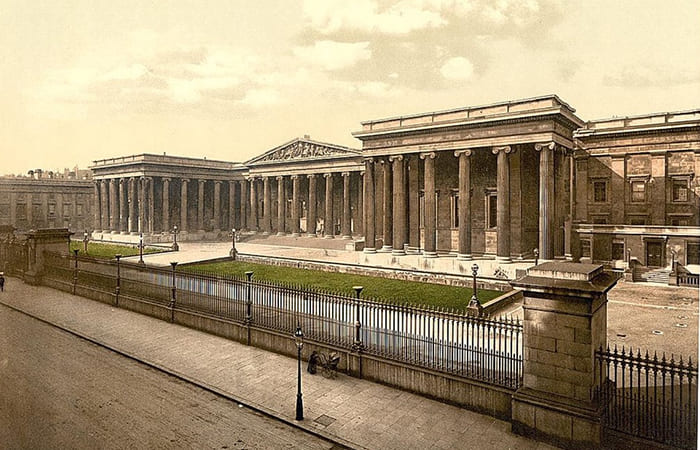
He agreed to leave this vast collection to the nation on the condition that it be preserved intact and made available to the public. This was a remarkable decision in the eighteenth century, when collections of this scale were often private or accessible only to a small scholarly elite.
The museum officially opened on 15 January 1759. This moment marked a turning point in the development of the national public museum, placing knowledge and artefacts into a shared civic space rather than behind private doors.
2. Its collection now includes around eight million objects
Any serious look at facts about the British Museum must acknowledge its scale. Today, the museum’s holdings are estimated at around eight million objects, representing cultures from every inhabited continent and spanning human history from prehistoric times to the present.
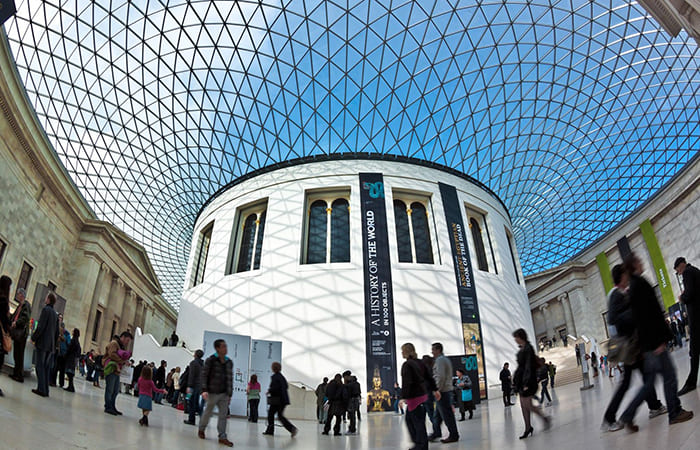
Only around 80,000 objects are on display at any one time. The majority remain in storage, are on loan to other institutions, or are being conserved and studied by researchers.
This means that what you see in the galleries is only a fraction of the museum’s full scope. Behind the public displays lies a vast research infrastructure that supports scholarship in archaeology, art history, anthropology and conservation.
3. Admission to the permanent collection is free
A widely appreciated fact about the British Museum is that entry to its permanent galleries is free. This policy reflects the founding principle that cultural knowledge should remain publicly accessible.
Each year, millions of visitors from across the world walk through its doors without paying an admission fee. This sustained commitment to public access and inclusion shapes the atmosphere of the museum, which remains open to families, students, scholars and independent travellers alike.
For those organising study holidays in London with us at Astrolabio, this accessibility makes it possible to include a visit without additional financial barriers. Students are able to encounter world heritage first hand, rather than studying it only through textbooks.
4. The Parthenon Marbles remain at the centre of international debate
One of the most debated facts about the British Museum concerns the Parthenon Marbles. These sculptures, originally part of the Parthenon in Athens, were removed in the early nineteenth century and later acquired by the museum.
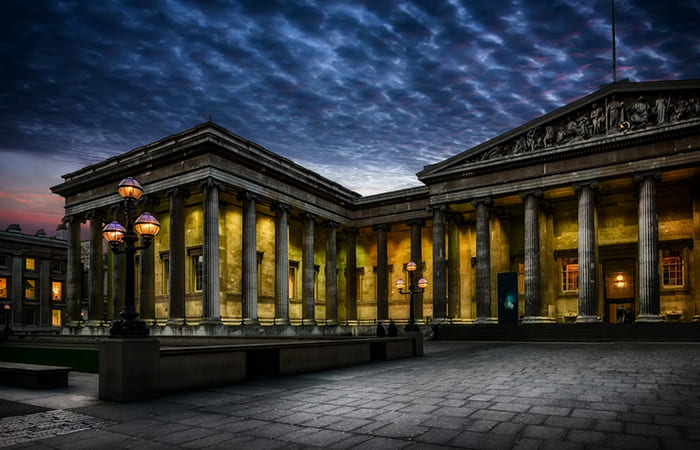
Their presence in London has prompted ongoing discussions between the United Kingdom and Greece. The debate addresses issues of restitution, cultural identity and the responsibilities of major institutions in relation to contested heritage.
Standing before the sculptures, you are engaging not only with classical art but with an evolving conversation about cultural ownership and historical accountability.
5. The Great Court reshaped the museum in 1997
In 1997, following the relocation of the British Library to St Pancras, the museum undertook a major architectural transformation. The central courtyard was redesigned by architect Norman Foster and reopened as the Great Court.
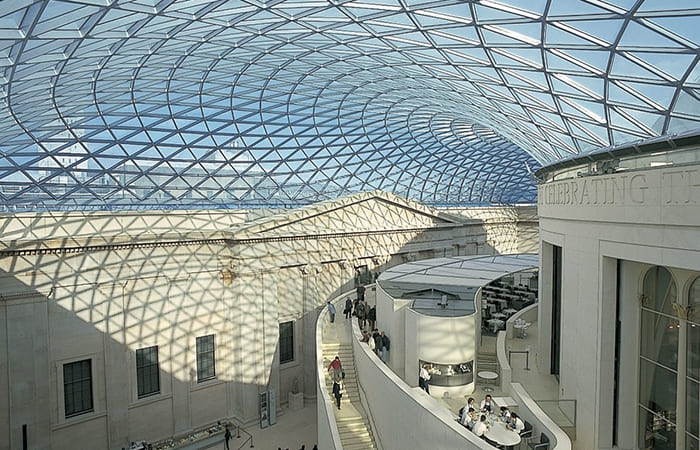
The space is covered by a glass roof composed of more than 3,300 uniquely shaped panels. This structure allows natural light to flood the interior while creating what is widely recognised as the largest covered public square in Europe, a remarkable example of modern engineering within a historic setting.
At its centre stands the former Reading Room, visually framed by the geometric roof. The Great Court fundamentally altered how visitors move through the museum, creating a sense of openness and architectural continuity that was previously absent.
6. It once housed a restricted “Secretum”
Until the 1960s, the British Museum maintained a restricted collection often referred to as the Secretum. Access required formal application and, in practice, was limited to male visitors.
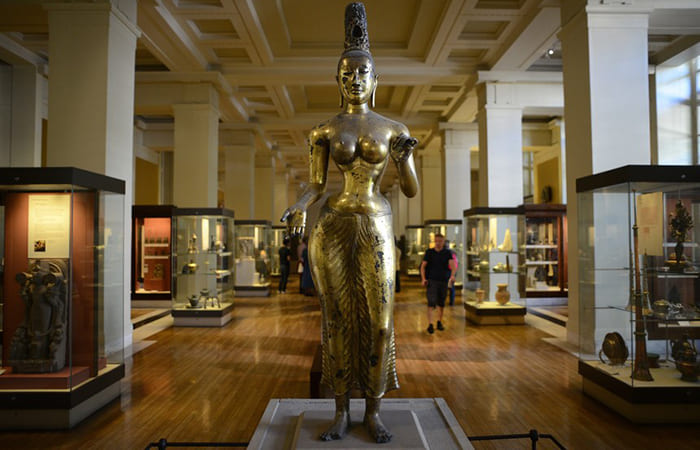
The objects in this section were considered inappropriate for public display under prevailing moral standards. Their separation reveals how institutional decisions are shaped by changing social attitudes and cultural norms.
This lesser known detail adds complexity to the facts about the British Museum. It shows that museums are not neutral spaces, but institutions influenced by the values and assumptions of their time.
7. It has served as a film location
The museum’s monumental architecture has attracted filmmakers for many years. Its galleries and exterior have appeared in feature films, documentaries and television productions.
One well known example is the 2014 film Night at the Museum: Secret of the Tomb, which used the British Museum as a key location. Its grand interiors and recognisable façade provide a visually striking setting that translates effectively to the screen.
This cinematic presence reinforces the museum’s place within contemporary popular culture, extending its influence beyond the academic and historical sphere.
8. The Reading Room was a centre of intellectual life
Before the British Library moved to its current building, the museum included the celebrated circular Reading Room beneath its imposing dome. For decades, it served as one of Britain’s most important research spaces.
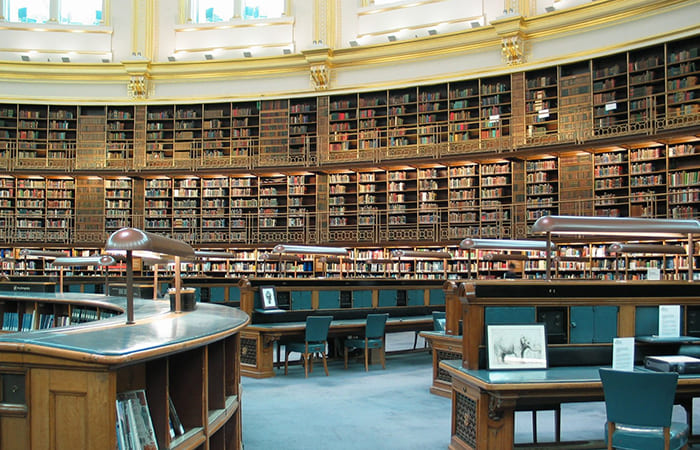
Writers and thinkers such as Virginia Woolf and Oscar Wilde studied there, contributing to its reputation as a hub of intellectual activity. The architecture itself became symbolic of scholarship and concentrated study.
Although the Reading Room no longer functions as a public library, its presence within the museum remains a reminder of the building’s dual identity as both exhibition space and centre of research.
9. It functions as a global research institution
Beyond the galleries, one of the most important facts about the British Museum is its role as a research institution. Curators and specialists collaborate internationally on archaeological projects, conservation initiatives and scholarly publications.
The museum supports excavations and long term research partnerships across the globe. This ongoing academic work ensures that collections are not simply preserved, but continually reinterpreted within new historical and cultural frameworks.
When you walk through the museum, you are witnessing the visible outcome of continuous research and preservation efforts. The displays are shaped by scholarship that evolves over time, ensuring that the British Museum remains an active participant in global cultural dialogue.