
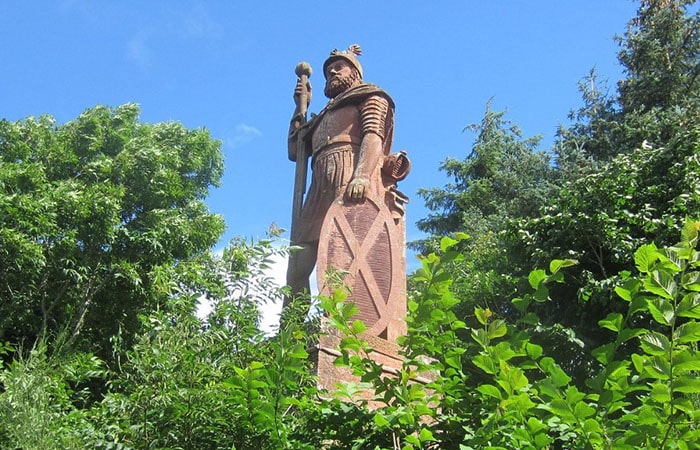
From Scottish history to Hollywood legend, William Wallace remains one of the most controversial historical figures ever portrayed on screen. In 1995, Mel Gibson transformed the life of William Wallace into a hugely successful Braveheart that is still remembered today.
The reality, however, is rather different. While the film accurately captures some parts of Wallace’s story, it dramatically exaggerates or invents many others. The historical inaccuracies range from the costumes to Wallace’s early life, much of which was created purely for dramatic effect. As so often happens in cinema, the true story was romanticised to make its hero even more compelling.
Even so, thanks to Hollywood, Braveheart is now recognised across the world!
What is true is that Scotland has long had a complex relationship with England, often referred to as “The Old Enemy”. It is also true that, before the Acts of Union in 1707, the Scots fought fiercely against English attempts to dominate their country.
Scotland’s national hero, William Wallace, led successful guerrilla campaigns against the English at the end of the 13th century. His military successes made him a legend, although the circumstances surrounding his eventual capture and death remain the subject of debate.
Who was William Wallace?
To many people, William Wallace represents the defence of a nation and the struggle for Scottish independence. To others, he was an outlaw, a murderer and a traitor.
So who was William Wallace, better known as Braveheart?
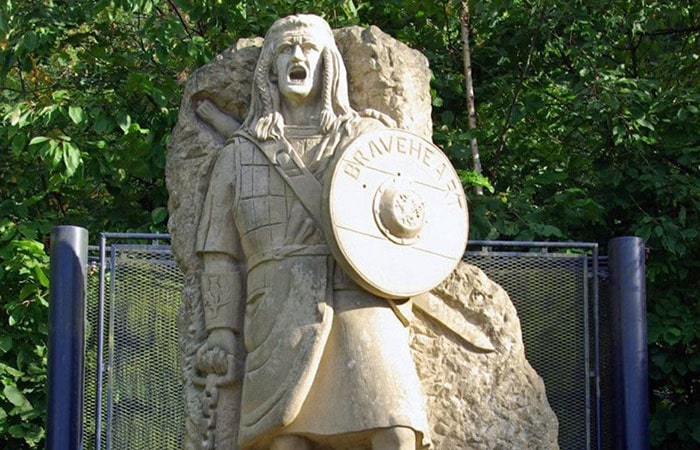
Very little is known about his life before 1297. Historians believe he was the son of a Scottish knight and a landowner. He appears to have received a good education and, judging by his later military achievements, it is thought that he may already have had some form of military experience.
Beyond that, little is known about his early years or his family. What is certain is that William Wallace’s rise to prominence was as rapid as his downfall.
Scotland in the time of William Wallace
In 1296, Scotland was conquered by England. Many Scots were imprisoned, heavily taxed and forced to serve King Edward I of England. These measures sparked widespread resistance against English rule.
William Wallace first entered the historical record after killing the English Sheriff of Lanark, William Heselrig. This act quickly made him famous and his name began to spread throughout Scotland.
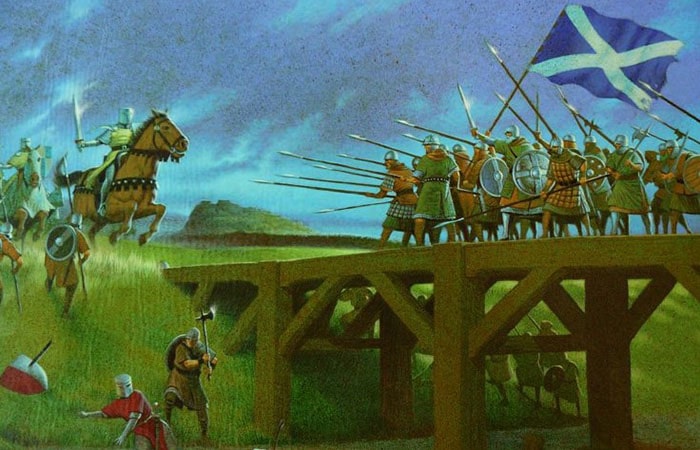
As his influence grew, Wallace and his followers launched attacks against English forces at Scone, Ancrum and Dundee. At the same time, rebellions were spreading across northern Scotland. Inverness and much of the north east were liberated by the young Andrew Murray, while Clan MacDougall drove English forces from the western islands.
Wallace’s rebellion gathered strength in the south and, with much of Scotland freed from English occupation, Wallace and Murray joined forces to face the English army.
On 11 September 1297, the two commanders won the Battle of Stirling Bridge. The English suffered devastating losses, with more than 5,000 soldiers killed, including their unpopular Treasurer, Hugh Cressingham. According to tradition, Cressingham’s flayed skin was taken as a trophy and used to make a sword belt for William Wallace.
Andrew Murray sadly died from his wounds a few months later, while Wallace was appointed Guardian of Scotland and Knight Commander of the Army of the Kingdom of Scotland.
By this point, however, Wallace’s fortunes were beginning to change.
The fall of the Braveheart legend
After their humiliating defeat at the Battle of Stirling Bridge, the English rallied behind King Edward I, who marched north with a much larger and better organised army.
This time, Wallace underestimated the strength of the English forces and suffered a crushing defeat at the Battle of Falkirk in July 1298.
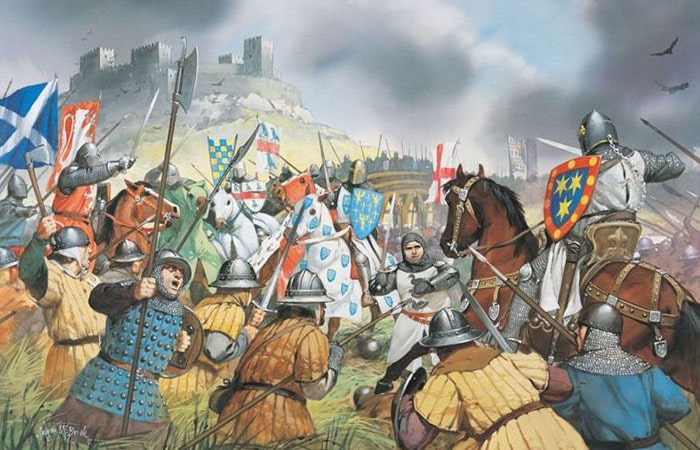
Wallace managed to escape the battlefield and little is known about his movements afterwards. Historical records suggest that he resigned as Guardian of Scotland and travelled abroad in search of support for the Scottish cause.
When he eventually returned to Scotland, he discovered that Robert the Bruce had agreed to a truce with the King of England. Wallace had not only been excluded from the negotiations, but a bounty had also been placed on his head, dead or alive.
He was captured near Glasgow in 1305, taken to London, charged with treason and executed.
His death was particularly brutal. He was hanged, drawn and quartered, his head was displayed on London Bridge, and the remains of his body were sent to Newcastle upon Tyne, Berwick, Stirling and Perth as a warning to anyone who might challenge the English Crown in the future.
Discovering Braveheart today
William Wallace remains one of Scotland’s greatest national heroes and continues to be seen as a symbol of Scottish independence.
For many people, Wallace embodies the spirit of Scotland itself and everything that makes the country’s rugged landscapes and history so distinctive.
Over the centuries, he has become more than a historical figure. He has become a symbol of freedom, inspiring not only Scots but people around the world who have fought for independence and self-determination.
Where to follow the story of William Wallace
Legend has it that, before his execution, Wallace was taken to a nearby well so he could drink one final mouthful of water as a free man. Today, that well is still known as Wallace’s Well.
One of the best places to begin exploring Scotland’s fight for independence is Dunfermline Abbey, the final resting place of King Robert the Bruce, who led the victorious Scottish army during the Wars of Scottish Independence.
The Abbey is also the burial place of seven other Scottish kings. Beside it stands Dunfermline Palace, where King Charles I was born.
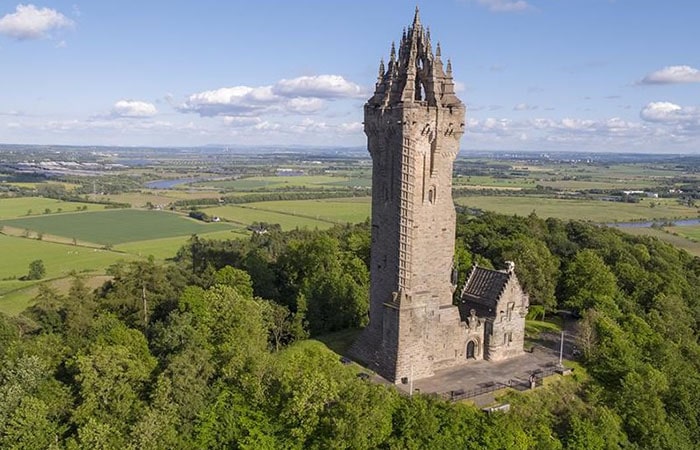
The National Wallace Monument is another unmissable stop. Built during the 19th century to honour Sir William Wallace, the tower has 246 steps leading to the top.
Inside, you can see Wallace’s famous two-handed sword, learn about his trial and gain a deeper understanding of the man who became Scotland’s greatest champion of freedom.
The views from the summit are equally impressive, stretching across the site of Wallace’s victory at Stirling Bridge and west towards Ben Lomond.
A visit to Stirling Bridge itself is another highlight. It was here, in 1297, that Wallace secured his greatest military victory.
Never before had a Scottish army defeated the English in an open battle, and the victory at Stirling Bridge marked the beginning of more than thirty years of fighting for Scottish independence.
During the Wars of Independence, Stirling Castle was regarded as the key to the Kingdom of Scotland. It became the focal point of many of the campaigns led by both William Wallace and Robert the Bruce.
Widely considered one of Scotland’s most important historic buildings, Stirling Castle remains one of the country’s finest castles and is well worth exploring.
No trip following Wallace’s story would be complete without visiting the Battle of Bannockburn Visitor Centre.
In June 1314, Scotland’s future as an independent nation hung in the balance. Robert the Bruce raised his standard and gathered his army to face the English forces led by King Edward II.
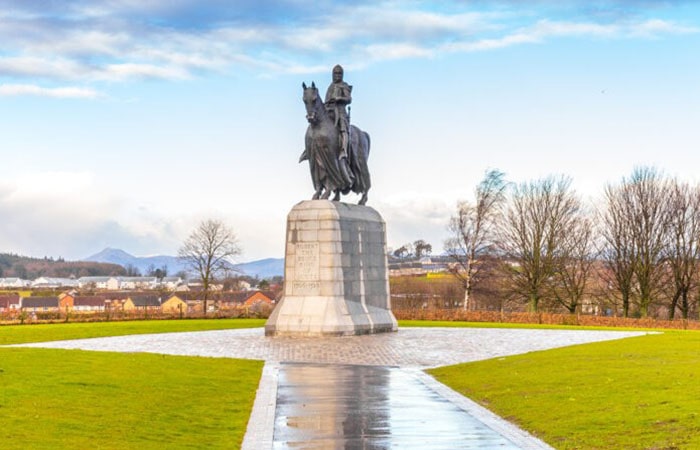
Today, you can walk across the battlefield and visit the Bannock Burn itself, the stream that played a decisive role during the battle.
Bruce’s remarkable victory at Bannockburn has echoed through Scottish history for centuries.
Even today, the site represents ideas of freedom, independence, patriotism, courage, perseverance and triumph against overwhelming odds. It has inspired countless works of art and literature, including Scotland’s unofficial national anthem, Flower of Scotland.