Wondering what to do in Central Park on your visit to New York City? Well, you’ve plenty of options!
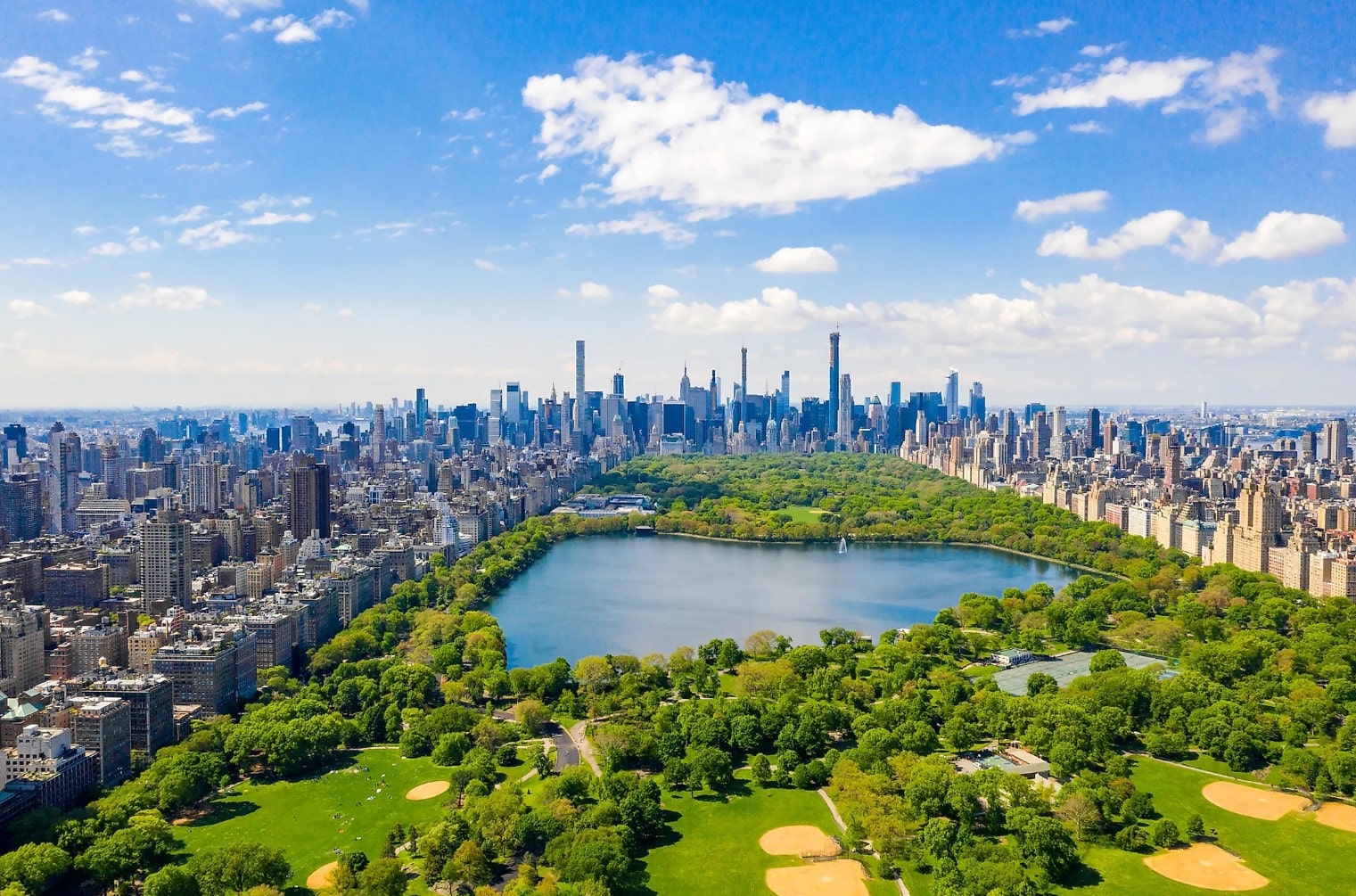
Covering around 843 acres in the heart of Manhattan, Central Park is one of New York City’s best-known attractions and one of its greatest green spaces. Loved by visitors and New Yorkers throughout the year, it’s a welcome break from the busy streets surrounding it.
Countless films and television series have been shot here over the years. Even if you’ve never visited before, there’s a good chance parts of Central Park will already feel familiar.
What to see in Central Park, the heart of Manhattan
Step inside Central Park and it can feel as though you’ve left the city altogether. It’s surprisingly easy to forget that Manhattan’s skyscrapers, busy roads and some of New York’s busiest shopping streets are only a short distance away.
Inside the park, you’ll find everything from scenic hills and open lawns to playgrounds, ice-skating rinks and famous attractions for children and adults. One thing to remember is that Central Park is huge, so don’t expect to see everything in an hour.
If you’re planning a visit, these are some of the places we think you shouldn’t miss.
Contents
Central Park Zoo
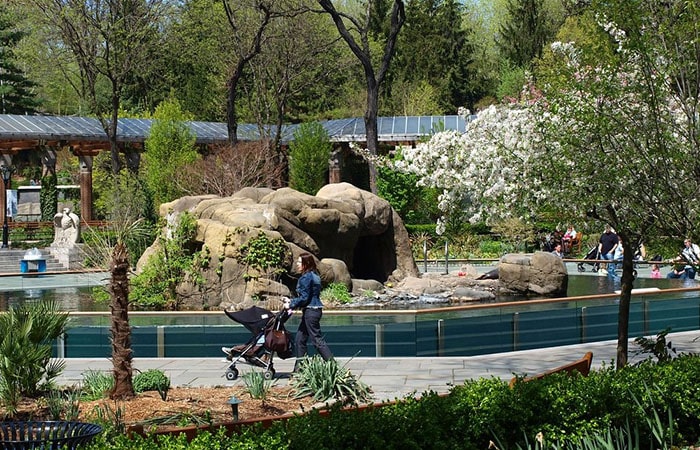
Central Park Zoo is home to animals from several different habitats, from tropical environments to the polar regions.
You can see animals including red pandas, snow leopards, penguins, grizzly bears and California sea lions, making the zoo an easy addition to a day exploring the southern part of Central Park.
The zoo also has a 4D theatre, which combines a 3D film with sensory effects. The experience is aimed at children aged six and over and isn’t recommended for children under four.
Between Central Park Zoo and the Tisch Children’s Zoo, you’ll also find the Delacorte Clock. Every half an hour between 8am and 6pm, bronze animals move around the clock while nursery rhymes and other tunes play.
Belvedere Castle
Belvedere Castle sits on Vista Rock, the second-highest natural point in Central Park, and offers views across the surrounding landscape.
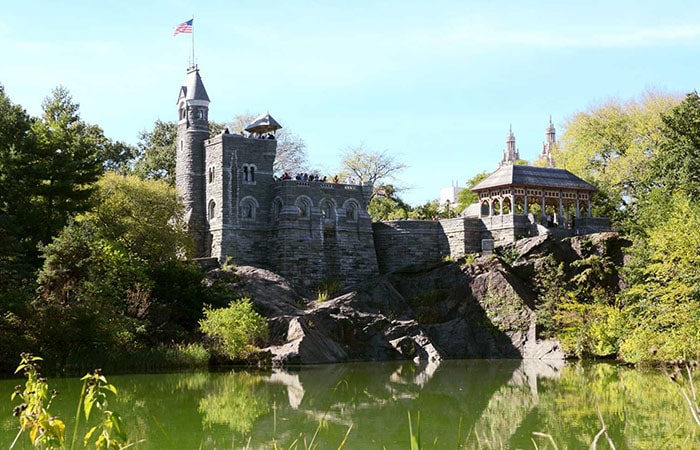
Look north and you’ll see Turtle Pond and the Great Lawn, while to the south lies the Ramble, one of Central Park’s woodland areas.
The Belvedere was designed by Central Park co-designer Calvert Vaux and architect Jacob Wrey Mould, with the complete complex finished in 1872. It was originally created as a place to enjoy views of the park rather than as a traditional castle.
It later became a weather station before falling into disrepair during the 20th century. It reopened as a visitor centre in 1983 and underwent another major restoration completed in 2019.
Today, you can head inside the castle and climb to its terraces for an even better view across Central Park.
Strawberry Fields
Strawberry Fields is a five-acre memorial to John Lennon, who was murdered in 1980 near the western edge of Central Park.
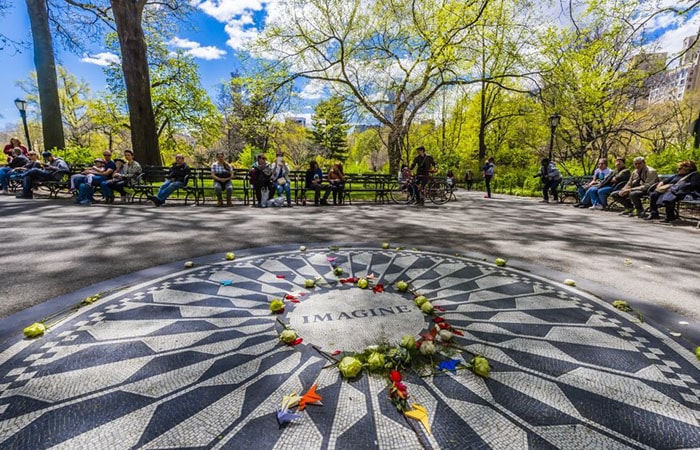
Set into the pathway is the famous Imagine mosaic, where visitors from around the world come to remember Lennon.
After his death, Yoko Ono helped develop the memorial as an international garden of peace. Countries around the world were invited to contribute plants and stones to the landscape.
Strawberry Fields remains one of Central Park’s designated quiet zones, making it a peaceful place to stop during your visit.
Conservatory Garden
The Conservatory Garden is Central Park’s six-acre formal garden and has a noticeably quieter atmosphere than many other parts of the park.
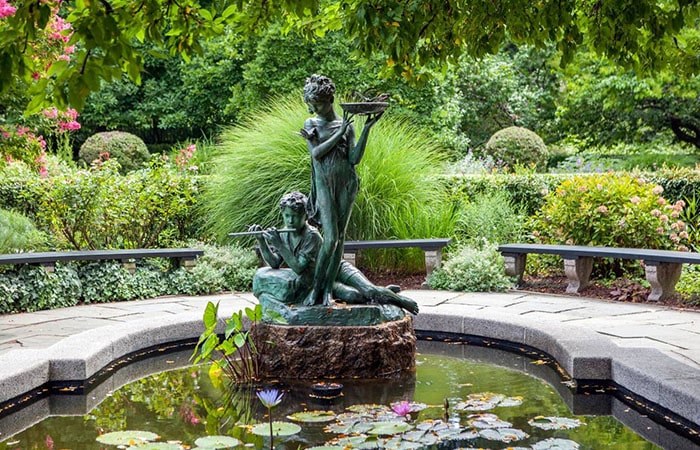
The garden is divided into three sections, each inspired by a different style: the French-style North Garden, Italianate Center Garden and English-style South Garden.
In the French garden, you’ll find the Untermyer Fountain and Walter Schott’s bronze Three Dancing Maidens. The Italianate garden has a large central lawn, fountain and wisteria-covered pergola, while the English garden is filled with mixed planting beds and flowering trees.
The gardens are particularly lovely in spring, when crabapple trees and tulips come into bloom. Its formal setting also makes the Conservatory Garden a popular location for small weddings.
Bethesda Fountain and Terrace
Bethesda Terrace and Fountain sit at the heart of Central Park, overlooking the Lake and close to the northern end of the Mall.
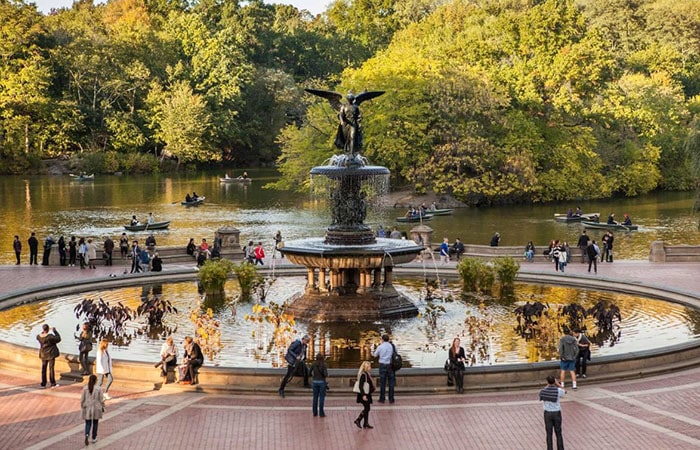
The terrace was designed as one of the park’s main gathering spaces and is known for its detailed carvings and extraordinary arcade. Look up inside the arcade and you’ll see a ceiling made from almost 16,000 decorative Minton tiles manufactured in Stoke-on-Trent in England.
At the centre of the terrace stands Bethesda Fountain, topped by Emma Stebbins’ bronze Angel of the Waters. The fountain was dedicated in 1873 and is one of Central Park’s most recognisable landmarks.
Bethesda Fountain is currently undergoing restoration and has been switched off while the work takes place. The project began in August 2026 and is expected to last around a year, but Bethesda Terrace remains open to visitors.
The Mall and Literary Walk
The Mall is a wide, straight pedestrian avenue running beneath a canopy of American elm trees.
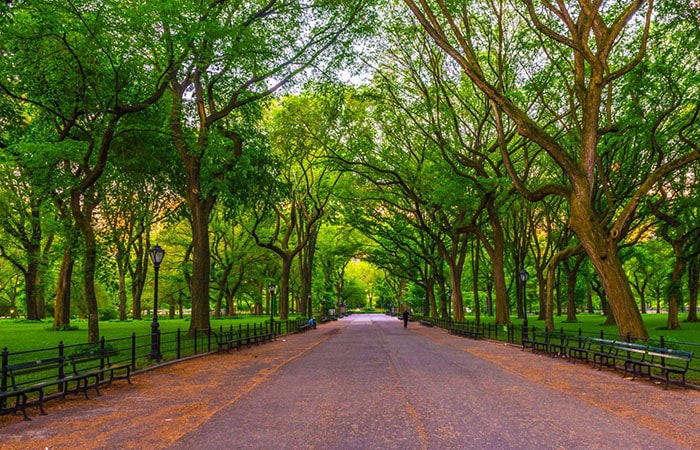
Designed as a formal promenade and gathering space, it’s somewhere to walk, sit and people-watch away from the surrounding Manhattan streets.
The avenue is particularly impressive because of its American elms, whose arching branches create a natural canopy above the path.
At the southern end of the Mall is Literary Walk, named after the monuments to writers found here. These include William Shakespeare, Robert Burns and Sir Walter Scott.
Central Park Carousel
The Central Park Carousel is one of the best-known family attractions in the southern part of the park.
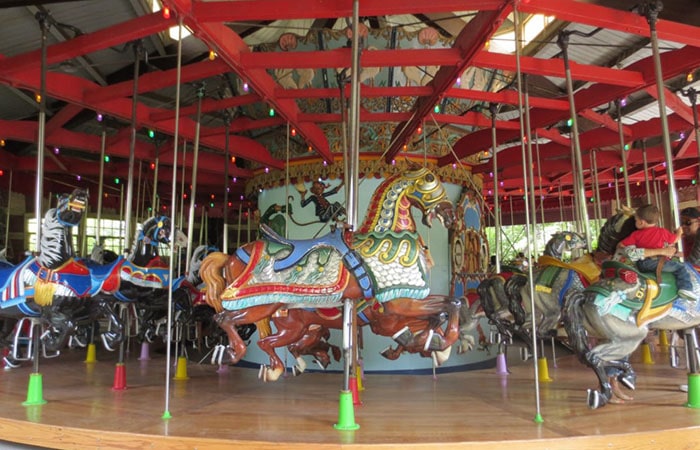
The current carousel dates from 1908 and was installed in Central Park in 1951. It’s actually the fourth carousel to stand in this location.
It features 57 horses and two chariots, accompanied by music played by a mechanical organ. Today, it’s regarded as both a historic carousel and a piece of American folk art.
Conservatory Water
Conservatory Water, on the eastern side of Central Park near 75th Street, is also commonly known as the Model Boat Pond.
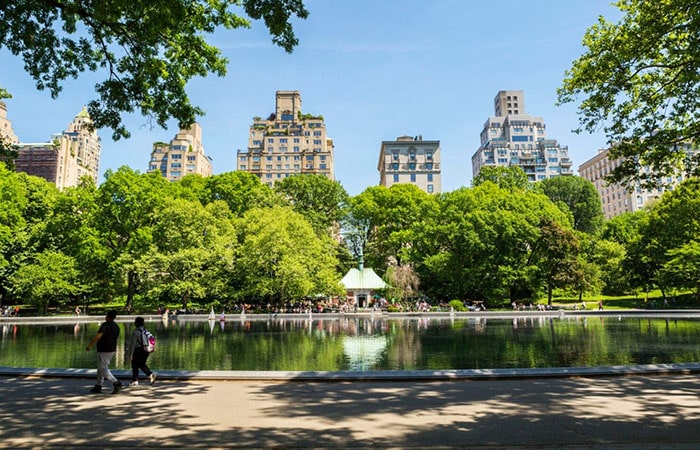
Children and model-boat enthusiasts have been sailing miniature boats here for generations, continuing a tradition that dates back to the 19th century.
The benches around the water make it a lovely place to sit, relax and watch the boats. You’ll also find two famous sculptures nearby: Alice in Wonderland and a monument to children’s author Hans Christian Andersen.
Ice skating in Central Park
If you’re visiting New York during the colder months, ice skating in Central Park gives you the chance to skate outdoors surrounded by views of Manhattan.
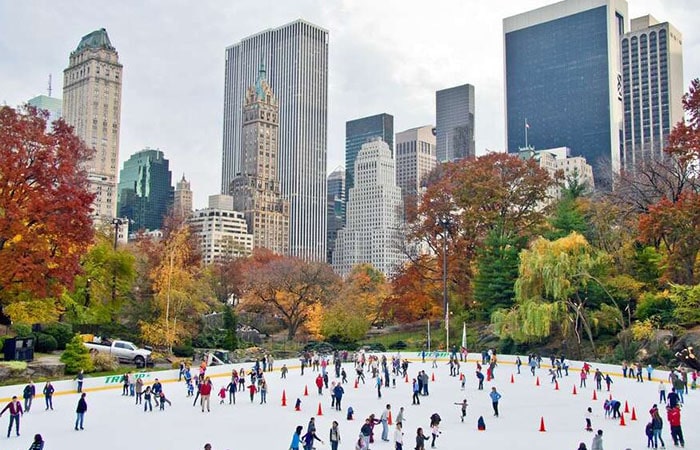
Wollman Rink, towards the southern end of Central Park, usually operates from October to April and offers public skating, skate hire and lessons.
At the northern end of the park, you can also skate at the Gottesman Rink at the Davis Center at the Harlem Meer. The Davis Center opened in 2025 on the site of the former Lasker Rink and Pool.
Its outdoor space changes with the seasons, operating as a swimming pool in summer, an ice rink in winter and a public green during parts of spring and autumn.
Cherry blossom in spring
Every spring, Central Park’s cherry trees fill parts of the park with pink and white blossom.
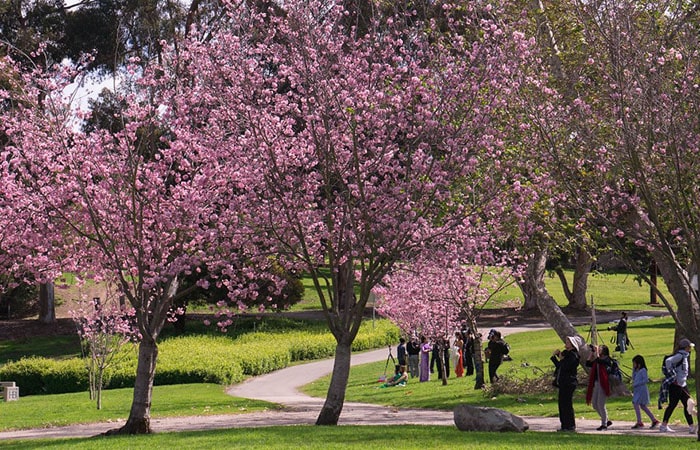
Two of the best-known varieties are Yoshino and Kanzan cherry trees. Central Park’s Yoshino cherries were a gift from Japan in 1912 and can be found around Cherry Hill and on the eastern side of the Reservoir.
Kanzan cherries produce distinctive deep-pink flowers and can be spotted in several areas of Central Park. One of the best displays is on the western side of the Reservoir.
The exact flowering period changes according to the weather, but the different varieties generally bloom at different points between March and May.
Alice in Wonderland
The Alice in Wonderland sculpture stands at the northern end of Conservatory Water.
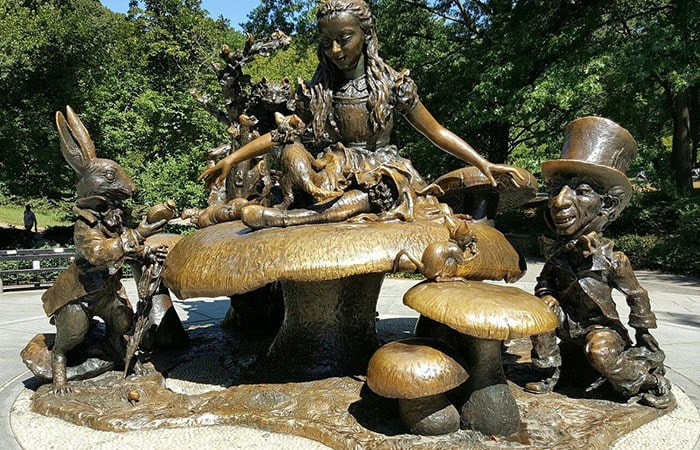
The large bronze sculpture shows Alice sitting on a giant mushroom alongside characters including the Cheshire Cat, Mad Hatter, Dormouse and White Rabbit.
It was given to New York City’s children by publisher and philanthropist George Delacorte and was created as a memorial to his wife, Margarita.
When the sculpture was unveiled in 1959, Delacorte’s grandchildren immediately climbed onto it. Children have continued doing exactly that ever since, leaving some areas of the bronze polished by decades of hands and feet.
Cleopatra’s Needle
It might seem strange to find an ancient Egyptian monument standing in the middle of Manhattan, but Central Park is home to an obelisk around 3,500 years old
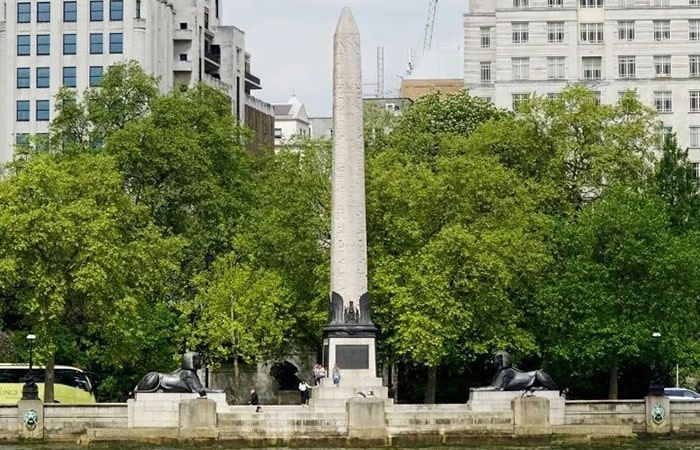
Known as Cleopatra’s Needle, the Obelisk was created around 1425 BCE in Heliopolis, Egypt. It was one of a pair commissioned by Pharaoh Thutmose III.
After spending centuries in Egypt, the monument was given to the United States by the Egyptian government and installed in Central Park in 1881.
Standing around 21 metres high, it sits opposite the Metropolitan Museum of Art and is covered in ancient Egyptian hieroglyphs. It’s the oldest outdoor monument in New York City.
Harlem Meer
At the northern end of Central Park, Harlem Meer offers a very different atmosphere from some of the park’s busier southern areas.
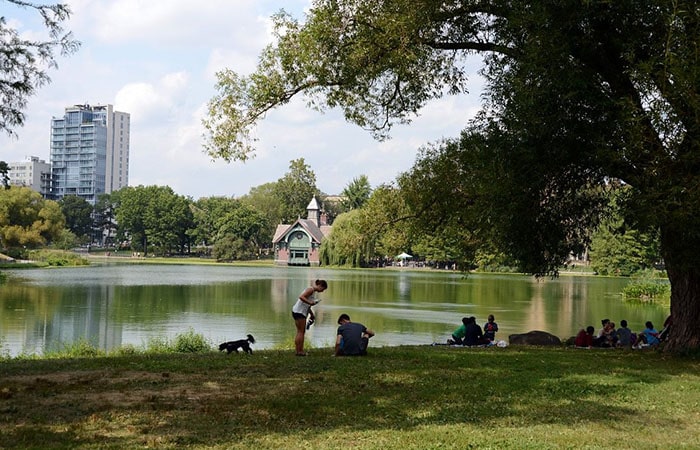
The biggest recent change to this part of Central Park is the Davis Center at the Harlem Meer, which opened in April 2025.
The new centre replaced the former Lasker Rink and Pool and was designed to provide year-round recreation while reconnecting this part of the park with the surrounding landscape.
Depending on the season, you can swim in the Gottesman Pool, ice skate at the Gottesman Rink or enjoy the public green. The surrounding area also includes restored shoreline, boardwalks and spaces where you can simply walk and enjoy one of the quieter corners of Central Park.
Now that you know what to do in Central Park on your New York study holiday…
Ready to experience it for yourself? Discover our New York study holidays and give your students the chance to learn English while experiencing one of the world’s most exciting cities.