
Contents
Since 1829, The Boat Race challenges Oxford and Cambridge every year on the River Thames in what has become one of the most prestigious regattas in the world.
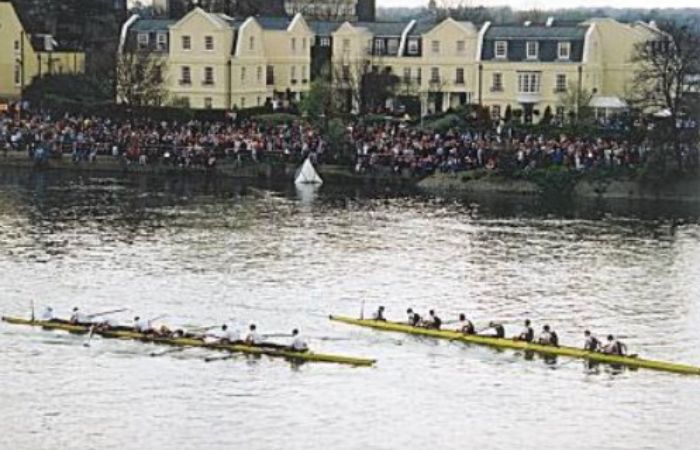
Each year, thousands of people line the banks of the River Thames to watch two crews go head-to-head in The Boat Race, where Oxford and Cambridge meet in one of Britain’s longest-running sporting traditions.
The Boat Race is simple in idea but huge in reputation. Two university teams, one stretch of river, and a rivalry that has lasted for nearly two centuries.
What started as a challenge between students is now followed by millions around the world, and it continues to carry the same mix of pride, competition, and tradition that it did at the very beginning.
What is the Oxford vs Cambridge Boat Race?
At its simplest, the Boat Race is a contest between two eight-oared crews: one from the University of Oxford and one from the University of Cambridge. But the scale and importance go far beyond a single race.
Each spring, four races take place: the men’s and women’s first crews, plus the second boats. These second crews are known by names rather than colours: Oxford’s Isis and Osiris, Cambridge’s Goldie and Blondie. For many rowers, a place in the second boat is still a mark of huge achievement, and the competition between them can be just as fierce as the main event.
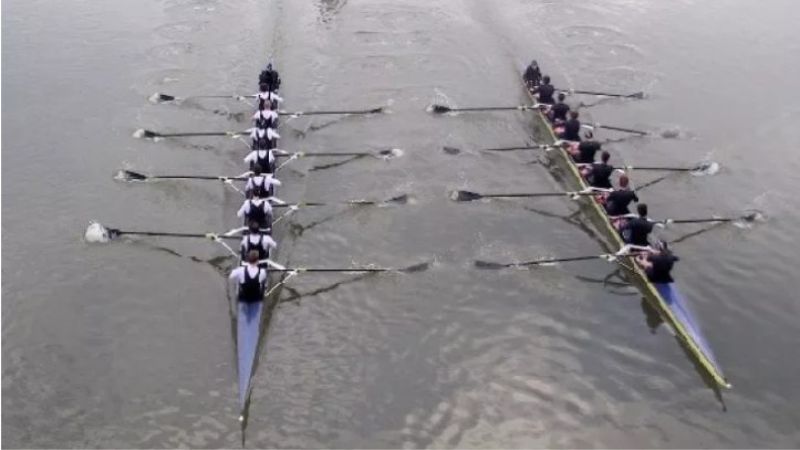
The Championship Course runs for 6.8 km between Putney and Mortlake in southwest London. It is a demanding stretch of the Thames, with sweeping bends and unpredictable conditions. Crews must cope with tides, wind, and the natural current, as well as the pressure of racing side by side in front of crowds that can reach a quarter of a million people lining the banks.
Television has made the race global. Since the BBC first broadcast it live in 1938, millions of viewers have tuned in from around the world. Today, the race is carried internationally, watched by alumni communities, rowing clubs, and casual sports fans alike.
A University Rivalry with Deep Roots
The academic competition between Oxford and Cambridge is centuries old, but in the 1820s it began to spill into organised sport. In 1827, Charles Wordsworth, an Oxford student with Cambridge family connections, arranged a cricket match between the two universities at Lord’s.
The match was rained off before a result could be declared, but Wordsworth’s enthusiasm for rivalry went further. While visiting his friend Charles Merivale at Cambridge, he suggested trying something new: racing in boats. At the time, rowing was growing popular among students and the upper classes. Boat clubs were being formed, and regattas on rivers like the Thames were becoming social events as well as athletic contests.
That conversation planted the seed of an idea that would outlast both men’s lifetimes.
The Birth of the Boat Clubs
In 1828, Cambridge officially founded the Cambridge University Boat Club (CUBC). This allowed regular races between colleges on the River Cam and quickly raised enthusiasm for rowing.
Oxford took longer to establish its own club, but the challenge had already been issued. In 1829, Cambridge formally invited Oxford to race, sending the proposal through boat builder Stephen Davis.
Oxford accepted, and the date was set: 10 June 1829.
Preparing for the First Race
Oxford initially struggled. Unlike Cambridge, they had no organised club or training system. That’s when Stephen Davis stepped in. A skilled boat builder with generations of family experience on the Thames, he took charge of preparing Oxford’s crew.
Davis built their boat, coached the team, and even suggested moving the race from London to Henley, a course he knew well. Thanks to his guidance, Oxford entered the first race well-prepared.
The First Boat Race: 10 June 1829
Henley was transformed that summer’s day. More than 20,000 people travelled by carriage, horseback, and on foot to witness the spectacle, which was an extraordinary crowd for the time. Among them were aristocrats, students, and curious locals.
Oxford wore dark blue, chosen by Christ Church College, while Cambridge appeared in light blue, echoing the colours of Eton College, where several of their rowers had studied. These colours became permanent markers of identity, instantly recognisable ever since.
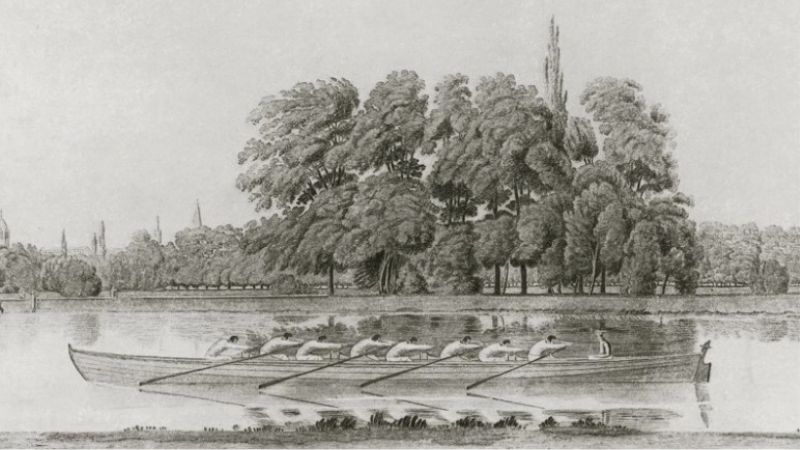
The race itself began with a false start, but once underway Oxford surged ahead. Their rhythm and power carried them clear, and they crossed the finish line first. The crowd erupted. A new tradition had been born.
For Charles Wordsworth and Stephen Davis, the victory was proof that their vision could succeed. For Oxford and Cambridge, it was the start of a rivalry that would define their sporting relationship for generations.
Building a Tradition
The Boat Race did not immediately become an annual fixture. The second contest took place in 1836, with Cambridge victorious. Over the next few decades, the race settled into regular rhythm, with victories trading between the two sides.
In 1845, the Championship Course between Putney and Mortlake was established. This stretch of the Thames, with its famous bends and bridges, has hosted almost every race since. Its challenges — especially the long Surrey bend and the sharp turn at Barnes — have become part of rowing folklore.
By the Victorian era, the race was attracting national attention. Newspapers reported it in detail, betting markets sprang up, and the annual contest became one of the highlights of the British sporting calendar. It also helped spur the creation of other rowing events, including the Henley Royal Regatta, which remains a global showcase for the sport.
The Women’s Race
While men had raced since 1829, women at Oxford and Cambridge were slower to be recognised. The first women’s race took place in 1927, though it was judged more on style than speed. For decades, women’s crews rowed separately, often on different stretches of river, and with far less coverage.
Change came slowly, but in 2015 the women’s race was finally placed on equal footing with the men’s. Since then, both have shared the Championship Course on the same day, with equal billing in broadcasting and promotion. This shift has been celebrated as a major step forward for gender equality in British sport.
The Boat Race in Modern Times
Today, the Boat Race is a global broadcast, a tradition rooted in history but watched in real time across continents. Alumni networks gather in pubs and clubs worldwide to cheer for their colours. Sponsors support the event, yet its amateur spirit remains: competitors are students, balancing training with demanding academic work.
The rivalry remains close. Cambridge leads overall with 84 wins to Oxford’s 80 in the men’s race, while the women’s tally is similarly competitive. Periods of dominance by one side are often followed by comebacks from the other, ensuring no team ever remains superior for long.
Training is intense. Rowers often wake before dawn to train on the water, followed by hours of gym work, all while studying full-time. For many, the Boat Race is the pinnacle of their athletic careers. Winning earns a permanent place in history.
Crowds along the Thames can still reach 250,000, lining bridges, towpaths, and pubs along the route. The BBC coverage, with cameras following every stroke, makes it one of the most recognisable rowing races in the world.
Why The Boat Race Matters
The Boat Race represents tradition, endurance, and the unique atmosphere of British university life. For students at Oxford and Cambridge, it embodies the intensity of competition and the pride of representing their college and university.
For spectators, it is a connection to history. The same river, the same contest, the same cheers echoing across generations. In many ways, it is less about sport than about belonging — to a team, to a university, to a tradition that has outlasted centuries.
Discover the Boat Race in the Oxford vs Cambridge Rivalry on Your Study Holiday with Astrolabio
This long-standing sporting rivalry is only one of the many things that make the atmosphere of Oxford and Cambridge so distinctive. But if you are lucky enough to plan a study holiday in England during the Boat Race, you could experience something truly unforgettable.
You would feel the anticipation in the air, share in the passion for the event, and have the chance to step into the heart of British student life while visiting two of the world’s most renowned universities.
It is an opportunity to experience the culture, history, and heritage of the British university system up close, while expanding your own horizons as you look ahead to future studies.